Escape room puzzles are very different from one another. Searching, codes, logic, observation, music, assembling pieces: each type calls for its own approach. If you know in advance what kind of puzzle is coming, you'll know where to start. These strategies work just as well in a game alone or in a small group as with a big table of friends.
Type 1: Searching and hidden objects
This is the basic puzzle: something is hidden in the room. A key under a rug, a note tucked behind a frame, an object that doesn't look like what it really is.
How to approach it
- Be methodical. Don't search at random: split the room into zones and go through them one at a time.
- Look twice. Important objects are often right in front of you: so obvious that nobody notices them, or placed where you walk past without paying attention.
- Listen to the game master's hints, if there is one. In online escape games where a character talks to the team, their reactions to discoveries are often a nudge in the right direction.
- Handle the objects that look like they don't belong. Lift, open, move. If an object is there, it's there for a reason.
Type 2: Codes and padlocks
A number to find, letters that spell a word, the combination of a three-digit padlock. This is the classic escape room puzzle.
How to approach it
- Look for hidden clues everywhere. A code almost never appears on its own: you have to combine information found in different places.
- Write down all the information, even the cryptic bits: a date found by chance, a string of numbers in a book, letters that don't form a word yet. Write everything down.
- Be wary of "obvious" codes: birthdays, memorable years, easy sequences like 1234 or 0000. Game designers know the codes you'll try first, and they often avoid them.
- Try variations too: reverse the sequence, try different orders, combine several clues.
Type 3: Logic and deduction
This is the thinking puzzle at its best. You're given several clues ("A doesn't like blue, B can't sit next to C") and you have to deduce the answer.
How to approach it
- Write these puzzles down. Make a small grid or diagram to see how the clues relate.
- Don't skip steps. Go slowly and check each deduction before you move on.
- When you're stuck, read the puzzle out loud. Hearing the words instead of just reading them sometimes makes the logic click.
- Use the progressive hints without hesitation. These puzzles become much more manageable with one extra precision.
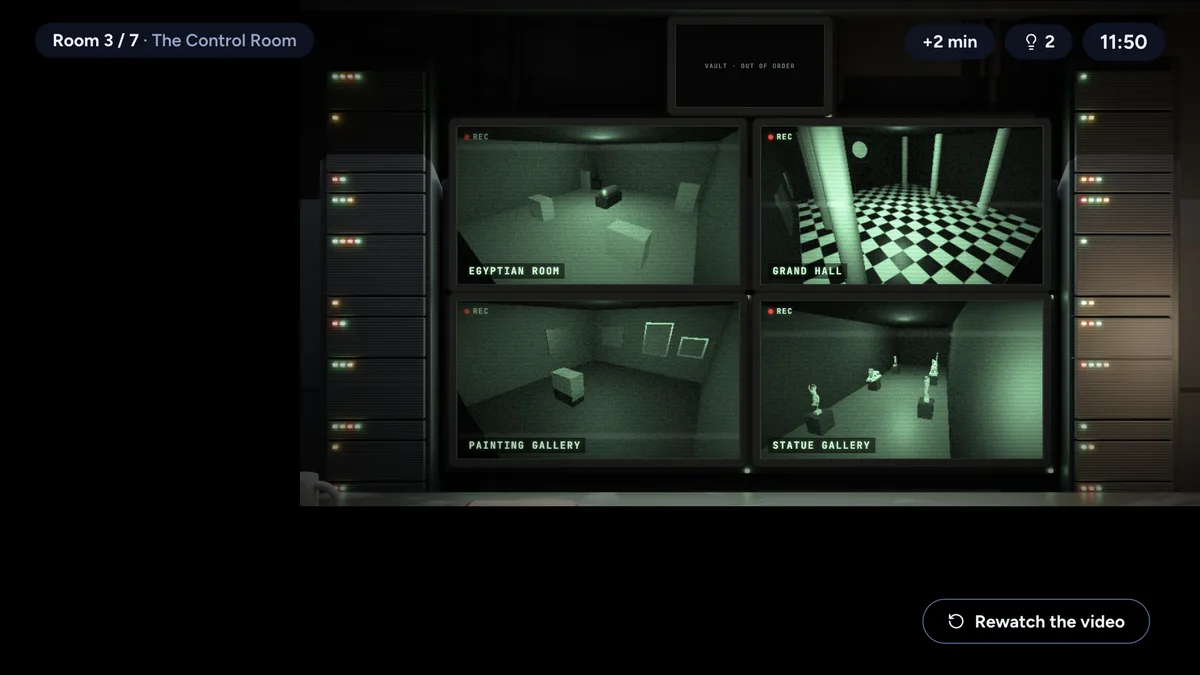
Type 4: Observation and visual details
Something is hidden in the image, or the answer is right in front of you and you just don't see it. A repeating pattern, an odd color, a detail that sticks out.
How to approach it
- Step back. Sometimes looking from a distance reveals a pattern you couldn't see up close.
- The reverse also works: examine the details up close, because some solutions only show up when you get near.
- Ask yourself: what looks wrong? What doesn't belong here? What's different from the rest?
- Work as a team. One person will see a detail that another missed. That's the big advantage of playing with several people: more pairs of eyes.
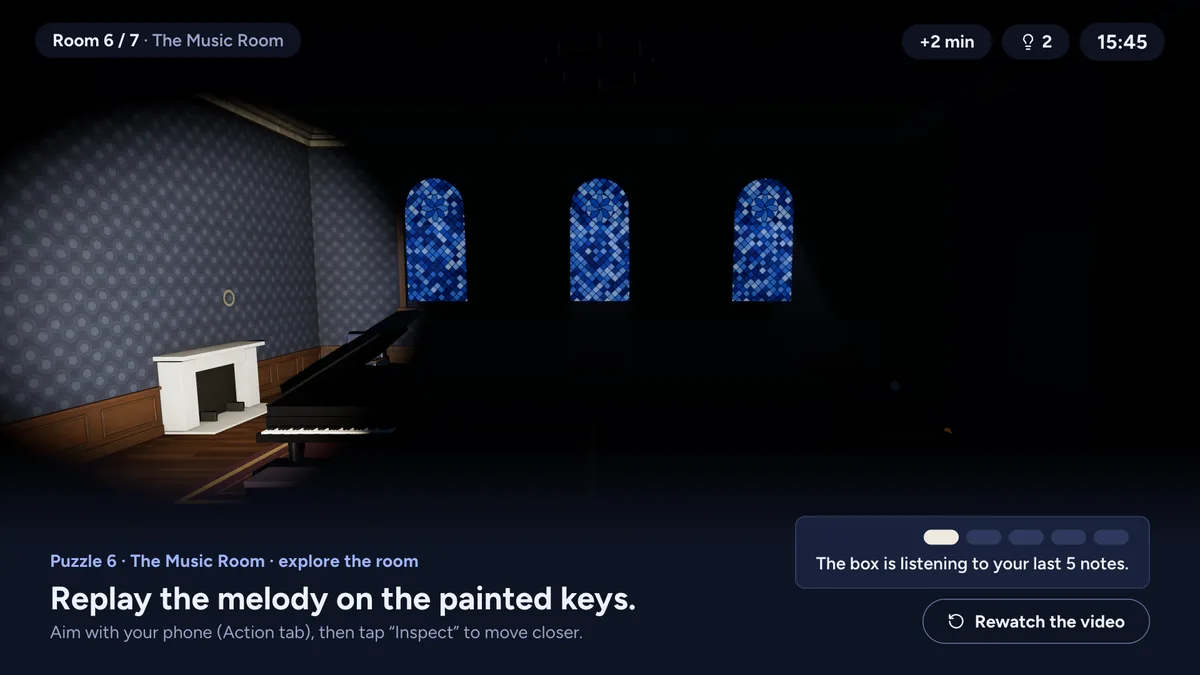
Type 5: Sound and music
A puzzle based on sound: a melody, background noises, a series of notes that form a code. It's less common, but good escape games use it happily.
How to approach it
- Listen several times. On the first listen you often miss a detail. On the second, you catch it.
- Write down what you hear: the notes of a melody, the order of the sounds, the differences between two passages.
- If it's music, think in notes (do, re, mi, and so on). If the melody sounds familiar, try to identify it.
- Some escape games provide a "key" to decode the sound, for example a table that matches each note to a number. Look for that key elsewhere in the game.
Type 6: Assembly and combination
You have several pieces (fragments of a document, puzzle pieces, parts of a photo) and you have to put them together to find the answer.
How to approach it
- Gather all the pieces first. Don't start assembling until you're sure you have everything.
- Understand the logic of assembly. Do the pieces fit physically, or do they link through logic (chronology, color, theme)?
- For a classic jigsaw, start with the corners and edges.
- For a torn document, look for visual clues like page numbers or sentences cut in half that help you put the pieces back in order.
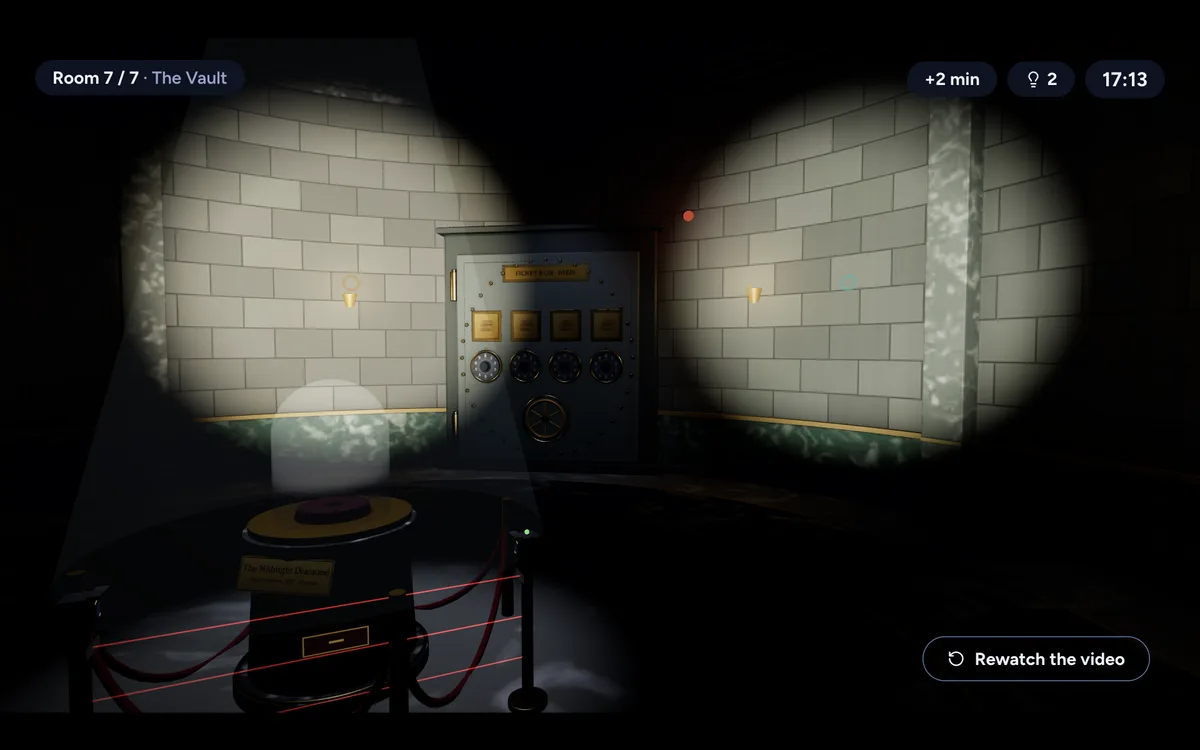
Team strategy
Whatever the type of puzzle, how the team is organized matters as much as the thinking itself. Here are the habits that make the difference, in any game.
Split the tasks. If one person reads well, they handle the written puzzles. If another has a sharp eye, they focus on observation. The team saves time.
Say what you find. Not just the answer: the path that leads to it. Saying "I found a code, but I don't know where to enter it" is already useful.
Use the progressive hints. Taking a hint isn't cheating. You get a piece of information that makes the puzzle easier. It's built into the design of the game.
Learn from wrong answers. A rejected answer rules out one lead and can point you toward the right one. But don't try everything at random: in many games, blind guesses cost time.
What we saw in testing. In mid-October 2026, during our first test sessions, three teams of two finished After Hours at the Museum in 1 hour 25 minutes, 1 hour 40 minutes and 2 hours 24 minutes, asking for between 4 and 9 hints. To prepare the evening, see how to host an escape game at home and the guide on playing solo or for two.
In an online escape game
If you play an online escape game, these six types of puzzles show up there too. The format changes a little: you search a 3D room on the TV rather than a real space, with your phone as a flashlight, but the mechanics are the same.
Each player receives different clues depending on their role. It's impossible to get through without talking to each other and piecing the puzzle together. That's the point: nobody has the full answer on their own.
The importance of roles and specialization
In After Hours at the Museum, each of the four roles has its own tool. The Archivist examines details under a magnifying glass, the Egyptologist assembles two documents with his tracing paper, the Technician reveals hidden marks with his UV light, and the Musician handles sounds with her tuning fork.
When you play for two or solo, you take on several roles. You get access to more clues, but you also have to read and remember all of them. Less specialization, but more fluidity.
With more than two players, each person can really focus on their area. Everyone feels useful and contributes with their strengths.
Adjusting your approach to the group size
Your strategy changes depending on whether you're two or four. With two players, you have more freedom to experiment and correct each other. With four, you need to communicate more clearly, because nobody has the full picture.
With four, say out loud what you're doing, so two people don't end up working on the same lead. With two, you pass the lead back and forth as the inspiration comes. How a game unfolds is explained on the how it works page.
The best strategy stays the same for everyone: listen to each other, write down what you find, test your ideas, and move forward together. When you're stuck, take a progressive hint without guilt. Questions? Our FAQ has more details on how the game works.