Escape room or escape game at home: which one should you pick for a night of mystery? Booking a physical room and playing at home are both good formats, but they feel very different. Here is what you need to know to choose.
Escape room vs. escape game at home: the price
Price is usually the first question. How much does a physical escape room cost? In Paris, a physical escape room typically runs between €25 and €40 per player, depending on the venue, the team size and the time slot. The price per person drops as the team grows, because the room is rented by the session. Here are two examples taken from the pricing pages in October 2026:
| Players | The Game, Paris | Escape Hunt, Marseille |
|---|---|---|
| 2 | €55 per person (€110) | €35 per person (€70) |
| 3 | €42 per person (€126) | €29 per person (€87) |
| 4 | €37 per person (€148) | €26 per person (€104) |
| 5 | €34 per person (€170) | €23 per person (€115) |
The figures are for French venues and in euros. Check the prices where you live before you decide.
For two people, a physical room is the most expensive option per person. For a group of six, expect roughly €150 to €240, plus the trip in many cases.
At Escape & Chill, an escape game at home is bought once, by the person who creates the games (the price is on the pricing page). The other players pay nothing. You can play as many games as you like with the same account. If you host another night next month, you don't pay again.
So the bigger your group, the more the home game saves you.
The atmosphere: the escape room wins
A real escape room engages all your senses. You're locked in a full set made of wood, paint and real objects. The puzzles are physical: you find an actual padlock, open it, and another mechanism starts. The light, the sound, everything around you is part of the story.
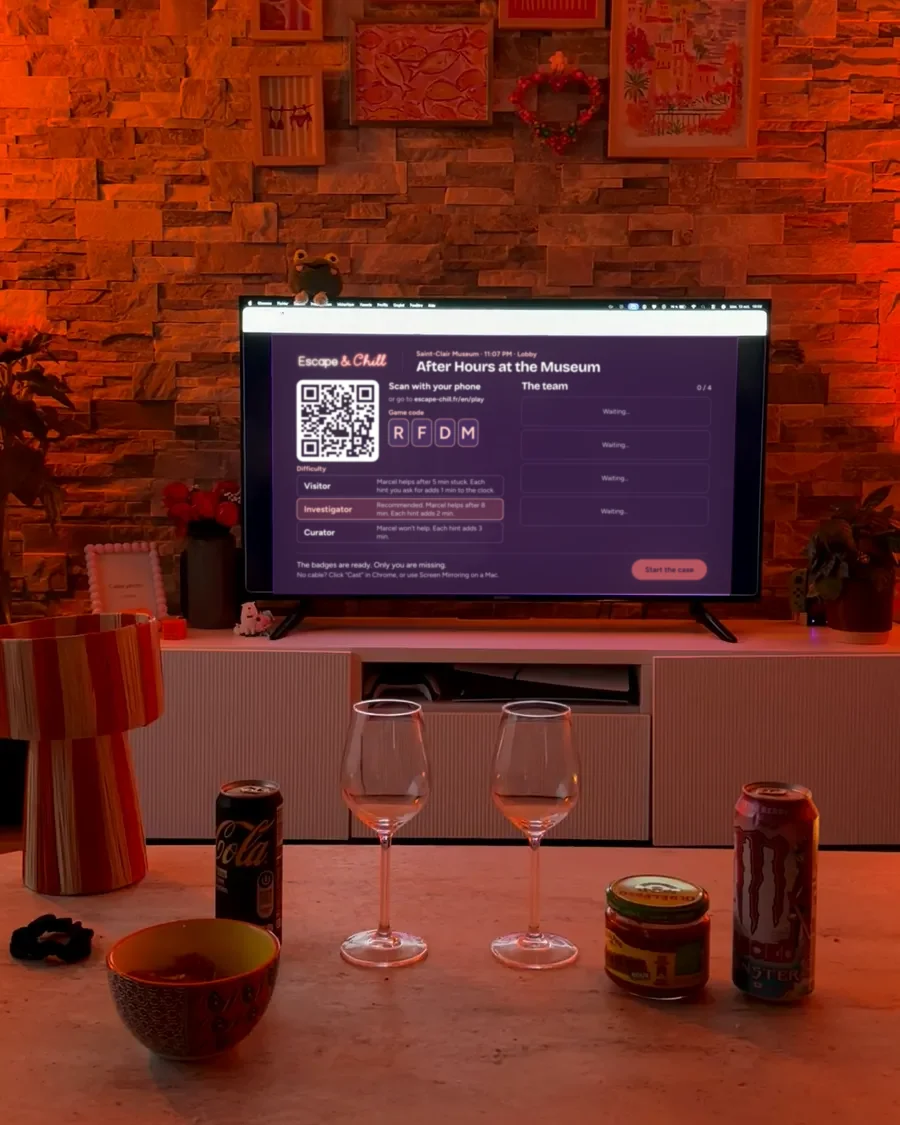
At home, the screen carries the atmosphere. The videos are well made and the rooms explore in 3D. But it's not the same as touching the walls of a real room or finding an object hidden behind a painting.
Verdict: if you want to be surrounded by a real set above all else, a physical escape room wins this round.
Comfort: home wins
You're at home. No trip, no tight schedule, nobody rushing you out the door. You can eat, drink, get up and sit back down. Nobody judges you.
In a venue, you're shut in a small room, the clock is ticking, and you keep wondering what you're allowed to touch. Even when it's fun, the setting feels a bit artificial.
Verdict: for real relaxation, stay home.
Time: the escape room is tighter
A physical escape room usually runs in a fixed slot, often about an hour. The clock is strict, because another team is waiting for its turn.
An escape game at home runs about 1.5 hours, but you control the pace: a pause in the middle, coming back the next day, long conversations or a quick run-through.
Verdict: if you like precision and structure, choose the room. If you prefer flexibility, stay home.
Making your own puzzles: the hidden cost
If you're thinking about making your own puzzles at home without a platform, it's a lot of work. You have to come up with puzzles, print them, hide them and remember the answers, especially if you're running more than one. That's hours of preparation for a 90-minute evening.
A physical escape room pays designers to do that work, and it's included in the price.
With a home escape game platform, the design work is already done. That's a big advantage if you host often.
Who's at the table?
In a physical room, you're usually locked in with a fixed group. If someone doesn't enjoy puzzles or the time pressure, they can't step away for the whole game. That's a strong commitment for a group night.
At home, the pressure drops. At worst, someone follows the investigation from the couch, looks something up on their phone, or steps away for a while. Nobody feels trapped.
Verdict: home suits mixed groups where not everyone is equally excited about puzzles.
The type of puzzles
A physical escape room offers a wide variety of puzzles because it has a real room to work with. You look for a clue under a table, listen to a message on a radio, decode a code on a wall, assemble an object. It's very hands-on.
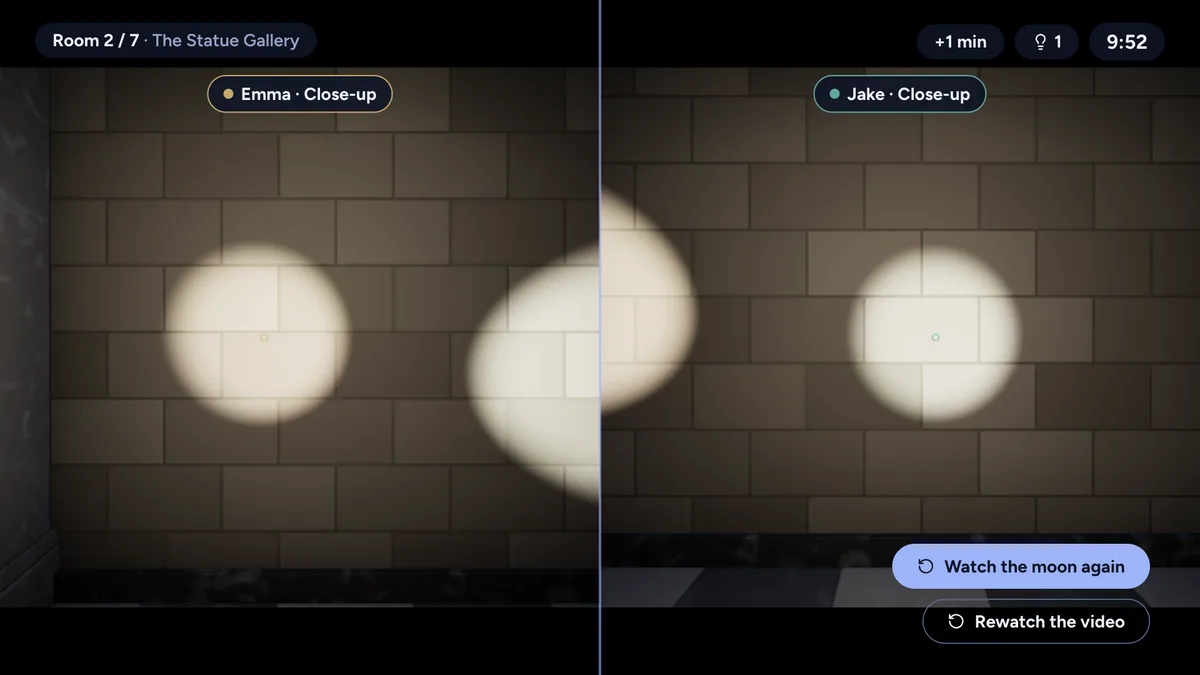
An escape game at home has real puzzles too, more visual and more cerebral. You explore a room on screen with your phone as a flashlight, you read the documents you receive, and you connect the clues. Thinking becomes truly collective.
Neither format is better than the other. They are simply different.
Preparing for the game
For a physical escape room, you have to book a specific time slot, sometimes well in advance, especially on weekends. Payment is often taken at booking, and a last-minute cancellation isn't always refunded. On the day, you have to get there and arrive on time.
For an escape game at home, you don't need a reservation. You start the game when you decide: a Thursday evening, a Saturday morning, between two video calls. If a friend drops out, you find a replacement an hour before, or you play with three instead of four. No date is locked in.
Verdict: if you like flexibility and plans that change at the last minute, home adapts better. If you like structured plans, a venue booking has the advantage of committing everyone.
Think about how often you'll play
Another question: will you play often, or is this a one-off outing? For a one-time occasion, a physical room justifies the cost. If you host regularly (once a month or once a quarter), the escape game at home quickly becomes the better deal. To get started, read how to host an escape game at home, step by step.
What we saw in testing. In mid-October 2026, during our first test sessions, three teams of two finished After Hours at the Museum in 1 hour 25 minutes, 1 hour 40 minutes and 2 hours 24 minutes, asking for between 4 and 9 hints. Without a booking or a trip, you can take a break whenever you like. See also our comparison of six home escape game formats, how to host an escape game at home, and our game night ideas for adults.
So, when should you choose which?
Choose a physical escape room if:
- You want to be surrounded by a real set, something you can touch and search.
- It's a special outing, not a monthly habit.
- Your group is uniform and everyone enjoys this kind of game.
- Everyone can pay for their own spot, or your friends can split the cost easily.
Choose an escape game at home if:
- You want a relaxed evening, with no trip and no tight schedule.
- You host often and prefer to pay once.
- Your group is mixed, and not everyone is equally keen on puzzles.
- You want an evening that costs little, whatever the size of the group.
- You prefer a game that's more mental than hands-on.
What you won't regret
Whichever you choose, both formats create a real group dynamic. You talk to each other, you concentrate together, and you shout with joy when a code finally opens. Moments like that are rare in everyday life, and they're what people remember.
If you're not sure, start at home with the free first room. You'll quickly see whether the format suits you. For a special occasion, nothing stops you from booking a real room afterward.
Choose the escape room for a real set and an outing that feels different. Choose the escape game at home for flexibility, comfort and regular game nights that don't break the bank.
To learn more about how the game works and the modes available, see how it works. The price and the free room are on the pricing page.