You've played every board game sitting on the shelf. You know Uno and poker by heart. The same faces show up every Friday, and somebody has to come up with something new so that everyone stops checking their phone. Here are ten game night ideas you'll still be talking about three days later.
1. Murder mystery with a printed script
A murder mystery is a small-scale role-playing game. Download a script online (many are free), print the character booklets, and hand them out fifteen minutes before. Each player knows who they are, their secrets and their clues, but not what the others know. As the night goes on, the lies pile up, someone shouts that they have proof, and everyone votes for the culprit. Plan on at least two hours. The best scripts create a night nobody forgets.
2. Trivia on a ridiculous topic
Run a quiz, but on a subject nobody really knows: Bollywood films, Eurovision songs, bizarre facts about animals. Form teams, prepare about thirty questions, and read them out loud. Competition works better when it doesn't depend on real expertise: everyone keeps their chances and stays focused. Add up the points at the end, and the losing team takes a forfeit.
3. A tabletop mystery with props
Go beyond the classic board games. Try a game like Sherlock Holmes Consulting Detective: a murder has been committed, and you receive documents, maps and scattered clues. The investigation can fill the whole evening. You get more invested than in a standard board game, and it's less demanding than a murder mystery. It's perfect for a small group of four or five people who like to think at their own pace.
4. Association and storytelling (Dixit)
Dixit is simple but addictive. The cards are large, dreamlike illustrations. Each round, one player picks a card and gives a word or a phrase as a clue. The others play a card from their hand that fits the clue, then everyone tries to find the storyteller's card. Nobody is ever quite sure, and the conversation keeps going: "Wait, why did you link that to 'Sunday'?" One or two inspired people are enough to get the game going. It's a calm game for a small group, and it leaves room for talk between rounds.
5. Local multiplayer on a console or computer
Bring out a console or plug a computer into the TV. Launch a chaotic action game (Super Smash Bros., Streets of Rage 4) or a party game (Mario Kart, Overcooked). The mayhem is part of the fun. Hidden talents come out: the person you thought was clumsy shows up with an unbeatable strategy. The rules are simple and the matches are quick. It's perfect for an hour of fun without much commitment.
6. A home escape game
Escape games exist in home versions too, without booking a room or paying per person. Boxed games like Unlock! or EXIT play on the table in about an hour. Printable kits can be hidden around the apartment, like a real room. And newer games play on a big screen, with everyone using their own phone. Whichever format you choose, the point is the same: you have to pool your clues, and the "Wait, what did you get?" moments start fast. To choose between these formats, see our comparison of escape games at home.
7. Light role-playing with dice
You don't need to be a Dungeons & Dragons fan. Games like Lasers & Feelings or Honey Heist play in one evening with funny characters and completely absurd situations. One player narrates the scene, the others decide what their characters do, and the dice settle the outcome. No prior knowledge is needed, and chaos is guaranteed.
8. Improv with constraints
Improv works well when there's a structure. Give each team a line they have to work into a scene: "I can't, I just saw him yesterday." "She's been wearing that hat for thirty years?" "And that's why pigeons never compromise." Each team plays two or three scenes, and the winning scene is the one where everyone laughs too hard to stop. No preparation, just ideas popping up.
9. A talent showcase
Ask everyone to prepare a ridiculous or impressive skill: play the theme from Jaws on a recorder, wiggle your ears, do an impression, perform a dance challenge. Each person shows their thing, and everyone votes for the funniest or most impressive. You discover talents you've been missing for ten years. The energy goes up a notch when the most shy person finally goes for it.
10. A competitive board game
Some board games become memorable not for their rules, but for the competition they create. Games like 7 Wonders, Splendor or Power Grid involve real strategy without being too heavy. Players shoot each other looks, and alliances form and fall apart in a minute. The length varies: 7 Wonders is quick, while Power Grid can fill the evening. Perfect if your group likes to think.
Principles that work
Whatever your game night idea, a few principles help a lot. First, mix competition with silliness: if everyone plays to win and never allows themselves to look ridiculous, the fun fades. Second, encourage talking. The more a game invites discussion, even as a joke, the more it brings the group together. Third, let people change their minds. If a game isn't landing, switch to something else. The best nights rarely follow the original plan.
Adjusting to the group size and the timing
The size of your group changes everything. With four or five people, you can go for something more intimate: a mystery game where everyone reads puzzles out loud, or a murder mystery where every character matters. With eight or ten people, choose games where people can split into teams naturally: trivia, a murder mystery, or an escape game in several rounds. Beyond ten, some people drift off quickly unless the pace stays up.
Timing matters too. A night that starts at 8 PM usually wraps up around 11 PM. If you keep an hour for settling in and catching up, a 90-minute escape game started at 9 PM ends at 10:30, and the evening winds down easily. To fit in several activities, favor short games of 30 to 45 minutes over one long game that takes up the whole night.
Classic board games you already know. Escape games at home ask more of people: you search, you deduce, and you argue a little about the right answer. Murder mysteries and improv rely on everyone's creativity. Local video games raise the energy in no time. It's up to you which mood you want.
If not everyone is in the same place, read our guide to remote escape rooms. A good night is mostly about the people. Anything works if someone makes the others laugh at the right moment. For more on mystery games, see the six types of escape room puzzles. And for more ideas for nights with friends, see our with friends page.
Escape & Chill (we make it)
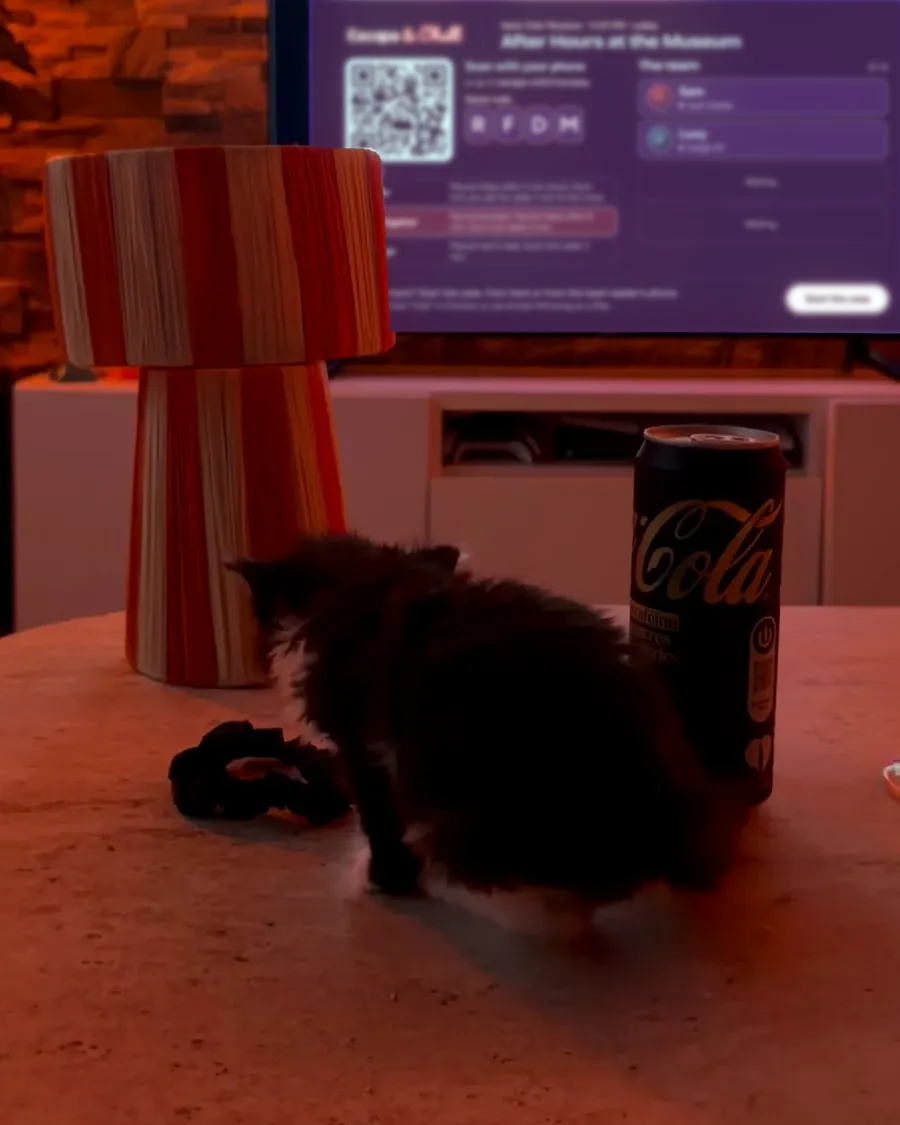
We make Escape & Chill, an escape game you play on the big screen (a computer connected to the TV). Each player scans a QR code with their phone, the room appears in 3D, and everyone searches it with their flashlight, getting clues the others can't see. The first game, After Hours at the Museum, is for 1 to 4 players and takes 1.5 to 2 hours, and the first room is free. With more than four, form pairs around one phone, or play two rounds and compare times. The full details are on how it works.
What we saw in testing. In mid-October 2026, during our first test sessions, three teams of two finished After Hours at the Museum in 1 hour 25 minutes, 1 hour 40 minutes and 2 hours 24 minutes, asking for between 4 and 9 hints. To compare with a real room, read our escape room vs. escape game at home guide. For a small group, see escape rooms for two.